State Department Permits Potential Sale of KC-46A Refueling Aircraft to Qatar
08/23/2026 / By Douglas Harrington
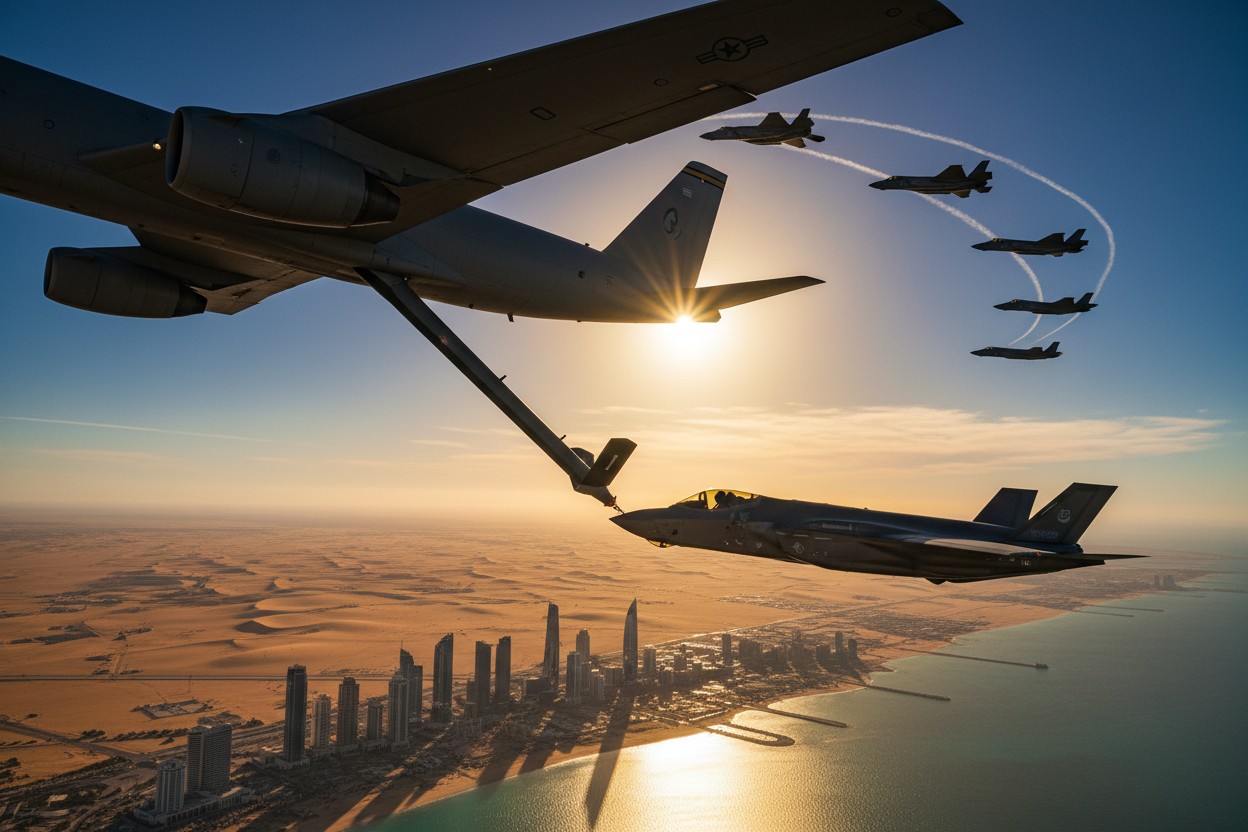
The U.S. Department of State has approved a possible Foreign Military Sale to Qatar of up to four KC-46A Pegasus aerial refueling aircraft and related equipment, with an estimated total cost of $4.50 billion, according to an Aug. 20 department announcement.
The proposed sale is not final, and Congress can pause the transaction, officials said. “The proposed sale will increase Qatar’s capability to meet current and future threats by enhancing its defense capabilities and interoperability with U.S. and allied forces and reinforcing Qatar’s strategic role in regional security,” the State Department’s Bureau of Political-Military Affairs said in a statement. [1]
Equipment, Services and Contractors in the Proposed Package
According to the State Department release, the requested package includes:
- Four KC-46A aircraft;
- Eight PW4062 turbofan engines, with four installed and four spares;
- Ten AN/ALR-69A radar warning receivers;
- Fifteen Guardian Laser Transmitter Assemblies for Large Aircraft Infrared Countermeasure systems, and;
- Eight LAIRCM system processor replacements.
The sale also covers missile warning sensors, cartridge-actuated devices, control interface units, KIV-77 crypto modules, KY-100M crypto terminals, electronic warfare database support and additional logistics and support elements, the department said. Principal contractors are The Boeing Corporation, Pratt & Whitney Military Engines, RTX Corporation, and Northrop Grumman Corporation. The U.S. government said it is not aware of any proposed offset agreement.
Gulf Security Context and Strategic Rationale
The announcement comes as U.S. allies in the Gulf have faced heavy attacks from Iran since the war between Washington and Tehran began in late February, when the United States launched “major combat operations” against Iran alongside Israel, according to the BBC. [2] Satellite imagery analyzed by BBC Verify showed that Iran has targeted key facilities across eight countries in the Middle East since the end of February, causing millions of dollars of damage to air defense systems, refueling aircraft, and radars. [3]
Iran has fired ballistic and cruise missiles and one-way attack drones at Gulf states, including Qatar. In July, the Islamic Revolutionary Guard Corps claimed it had destroyed a fighter aircraft maintenance and repair center and a command-and-control center at Qatar’s Al Udeid Air Base using ballistic missiles;
Qatar’s Ministry of Defense said its armed forces had intercepted a missile attack targeting the country, according to Middle East Eye (MEE). [4] Maj. Gen. Ali Abdollahi, chief of staff of the Iranian Armed Forces, said “any assistance or facilitation provided to the aggressor U.S. military amounts to participation in the U.S. military operation” and that it “seems unlikely that such a large number of military aircraft, particularly refueling aircraft, could be present at regional bases without knowledge of host countries,” according to Iran’s Mehr News Agency as reported by MEE. [5]
The State Department said the proposed sale supports U.S. foreign policy and national security objectives by improving the security of a strategic regional partner and that it “will not alter the basic military balance in the region.”
Congressional Review and Implementation Outlook
The sale remains tentative because Congress could place a pause on the transaction, according to the department. The notification of a possible sale does not constitute a contract, and final terms would be subject to negotiation following the congressional review period, officials said.
The State Department said Qatar “will have no difficulty absorbing these articles and services into its armed forces.” Implementation of the proposed sale will not require additional U.S. government or contractor representatives in Qatar and will not adversely affect U.S. defense readiness, the release stated. [1]
Strategic Significance and Outlook
The proposed sale adds to a U.S. military footprint in the Gulf that analysts have described as a strategic cornerstone of American policy for securing oil supplies, protecting allies, and deterring regional threats. [6] Aerial refueling has proven hazardous during the current conflict. In March, six U.S. service members were killed when a U.S. refueling jet crashed in Iraq, according to MEE. [7]
Military airlift and refueling have long been central to U.S. power projection. One historical account of the early Air Transport Command observed that on July 1, 1942, the command possessed just 24 long-range transports, none of which was satisfactory. [8]
The proposed sale also comes amid broader aerospace competition. One analysis noted that Washington blocked deliveries of carbon-fiber composites to Russia following the appearance of the MC-21, a narrow-body airliner intended to challenge Western aircraft. [9]
References
- State Department OKs Possible $4.5 Billion Military Refueling Aircraft Sale to Qatar. – The Epoch Times. August 20, 2026.
- What to know about the US-Israeli attacks on Iran. – BBC. March 1, 2026.
- Iran attacks damage 20 US military sites since start of war, satellite images show. – BBC. June 1, 2026.
- IRGC claims attacks on US Gulf military assets, stops second ship in Hormuz. – Middle East Eye. July 12, 2026.
- Iran Sternly Warns Gulf Nations Against Helping America. – NaturalNews.com. August 20, 2026.
- America’s Gulf war machine: What we know about the US military network in the Middle East. – RT. March 7, 2026.
- Six Americans killed after US refueling jet crashes in Iraq. – Middle East Eye. March 13, 2026.
- Oliver La Farge. “The Eagle in the Egg”.
- Andrei Martyanov. “Disintegration Indicators of the Coming American Collapse”.
Explainer Infographic

Submit a correction >>
Tagged Under:
big government, chaos, collapse, dangerous, department of state, Foreign Military Sale, foreign relations, KC-46A Pegasus, military, military purchase, military tech, military technology, military-industrial complex, national security, Qatar, refueling aircraft, United States, violence, weapons technology, White House, WWIII
This article may contain statements that reflect the opinion of the author
RECENT NEWS & ARTICLES